


















Qingmei Future Insights
AI Marketing ROI Optimization Best Practices – Performance-Driven
In the era of digital marketing, AI has become a core driver of marketing return on investment (ROI). As budgets tighten and competition intensifies, using AI to optimize for results has become an essential skill for every marketer.
Build a Data-Driven Marketing Foundation

Data collection and integration
The first step in AI marketing optimization is building a robust data collection system. Companies need to integrate data from multiple touchpoints, including website behavior, social media interactions, email responses, and customer service records. A unified data platform ensures data quality and consistency, providing reliable training data for AI algorithms.
Modern businesses should invest in a customer data platform (CDP) to unify cross-channel data in real time. This improves data completeness and gives AI models richer features, raising prediction accuracy.
Construction of key indicator system
A sound KPI framework is the cornerstone of ROI optimization. Beyond traditional metrics like click-through and conversion rates, track deeper indicators such as customer lifetime value (CLV), customer acquisition cost (CAC), and shifts in brand awareness. AI systems can monitor these in real time and adjust marketing strategy automatically.
Precise customer segmentation and personalized marketing
AI-driven customer profiling
Machine learning can cluster customers across many dimensions, identifying groups with similar behavior and value potential. AI can process hundreds of variables and find combinations of traits that manual analysis would miss, making segmentation far more precise. By analyzing purchase history, browsing behavior, and social media activity, for example, AI can identify segments such as "price-sensitive quality seekers" and "impulsive frequent buyers," each with its own targeted marketing strategy.
Dynamic personalized content optimization
AI systems can generate and optimize personalized content in real time, including product recommendations, email subject lines, and ad creative. Through continuous A/B testing and machine learning, the system delivers to each user the content mix most likely to convert.
This dynamic optimization not only improves the user experience but also significantly lifts marketing performance. Research shows that AI-driven personalized marketing can increase conversion rates by 20-30%.
Intelligent channel configuration and budget optimization

Cross-channel performance attribution analysis
Traditional marketing attribution models are often oversimplified and fail to reflect the true contribution of each touchpoint in complex customer journeys. AI attribution models can analyze customers' paths across channels and identify the incremental value of each touchpoint. Using machine learning, the system can understand synergies between channels, avoid double-counting conversions, and provide more accurate guidance for budget allocation.
Real-time budget tuning
AI systems can automatically adjust budget allocation across channels and campaigns based on real-time performance data. When a channel's ROI exceeds expectations, the system increases investment there; when a channel underperforms, it promptly reduces spend.
This dynamic tuning ensures the marketing budget always flows to the highest-ROI areas, avoiding the lag and subjective bias of manual adjustments.
Predictive marketing and timing optimization

Customer Behavior Prediction
Using historical data and real-time behavioral signals, AI can predict key indicators such as purchase intent, churn risk, and value potential. Marketers can then take the right action at the right moment.
For example, when an AI system predicts that a high-value customer is at risk of churning, it can automatically trigger a personalized win-back campaign, significantly improving the chance of retaining them.
Intelligent marketing opportunities
AI systems can analyze each customer's behavior patterns to identify the best moment to reach them, including the best time to send emails, the best time slots for ads, and the right frequency for push notifications. Optimizing timing can significantly improve campaign response and conversion rates.
Marketing Automation and Efficiency
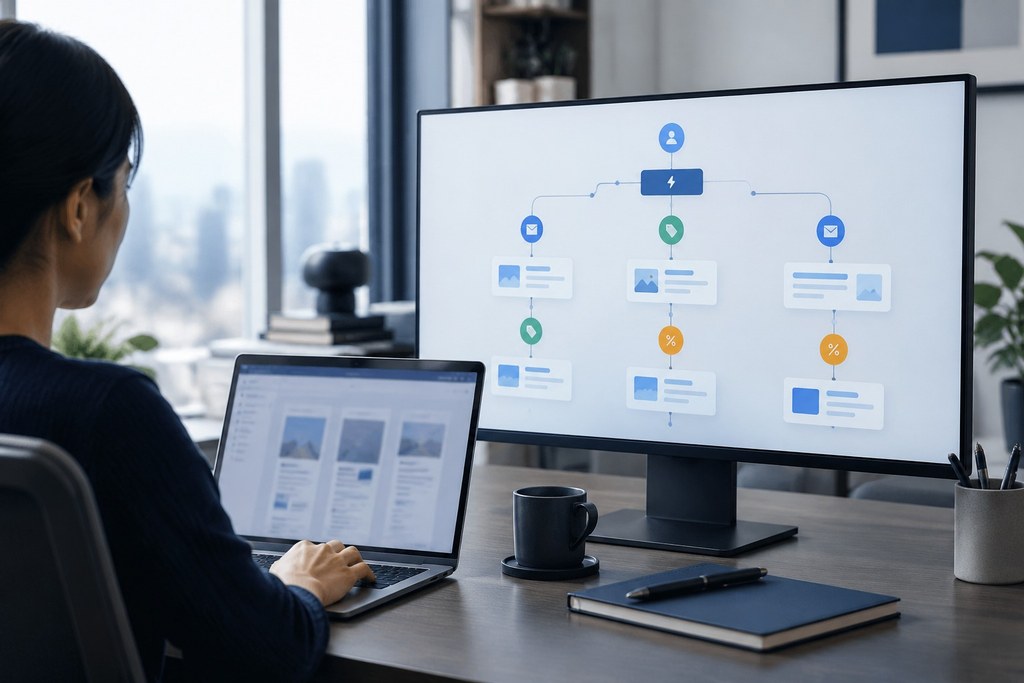
Intelligent Workflow Design
Build AI-based marketing automation workflows that trigger the right actions based on customer behavior. For example, when a user views a product page without buying, the system can send a personalized email with a coupon. When a customer completes a purchase, it can start a cross-sell sequence. This automation improves marketing efficiency and ensures timely, consistent responses, avoiding the gaps and delays of manual work.
Creative Generation and Testing
AI tools can automatically generate ad creative, email copy, social posts, and other marketing assets, then use intelligent testing to quickly identify the best-performing version. This cuts the time cost of creative production while increasing creative variety and effectiveness.
Continuous optimization and learning mechanism

Feedback closed loop construction
Build a robust feedback loop so the AI system learns and improves with every campaign. With real-time data collection and analysis, the system continuously refines its parameters, improving prediction accuracy and decision quality.
Diversified testing strategy
Advanced testing methods such as multi-armed bandit algorithms balance exploring new strategies with exploiting the best-known ones. The system keeps discovering better marketing approaches while maximizing current performance.
Risk control and compliance management

While optimizing ROI, brands must give equal weight to data privacy and compliance. Build transparent AI decision-making, ensure marketing activities meet regulatory requirements, and protect brand reputation and customer trust.
Conclusion
Optimizing AI marketing ROI is a systemic effort that requires coordinated progress across data foundations, technical capabilities, and organizational structure. By establishing data-driven decision-making, reaching customers precisely, and optimizing marketing timing and content, companies can significantly improve their return on marketing investment.
Successful AI marketing optimization doesn't happen overnight. It takes sustained investment and constant iteration. Start with small pilots, expand AI use step by step, and build experience and capability along the way, until marketing performance makes a step change.