


















Qingmei Future Insights
Supply Chain Transparency: A Visual AI Narrative of Global Trust Building
As global trade networks grow ever more complex, supply chain transparency has shifted from an optional competitive advantage to a condition for survival. Consumers, regulators, investors, and partners all demand greater traceability and accountability. Traditional supply chain management relies on paper documents, manual verification, and spot checks. These methods are inefficient and vulnerable to information gaps and fraud. Visual AI offers a fundamentally new solution. By combining computer vision, machine learning, and blockchain, companies can monitor the entire chain with new precision and at new scale, building trust on real data. This technology-driven transparency is reshaping how supply chains are managed and laying the technical foundation for restoring trust in global trade.
Transparency crisis and the need to rebuild trust

The complexity of modern global supply chains has outgrown traditional management methods. A typical consumer product may involve hundreds of suppliers across dozens of countries, with countless steps from raw material sourcing to final delivery. This complexity creates unprecedented transparency challenges, with recurring issues of information asymmetry, quality, ethics, and environmental pollution.
Information asymmetry is the root cause of mistrust in supply chains. Upstream companies often hold key information, while downstream businesses and end consumers lack access to accurate, complete, and timely information. This asymmetry undermines sound business decisions and erodes consumers' right to know and right to choose.
Frequent quality and safety incidents have deepened the crisis of trust. From food safety scandals to product defects, from pollution to labor abuses, each exposure shows how important and urgent supply chain oversight has become. Reacting after the fact no longer meets the need for prevention.
Ever-stricter regulation reflects society's growing demand for supply chain transparency. Governments around the world are introducing tougher laws that require companies to disclose detailed supply chain information and take on corresponding social responsibilities. Rising compliance costs are driving demand for transparency technology.
Growing consumer awareness has become a major force for transparency. Younger consumers in particular care more about where products come from, how they're made, their environmental impact, and their social responsibility. This shift is reshaping demand, giving transparent brands a competitive edge.
Investors and financial institutions are also driving greater supply chain transparency. As ESG investing becomes mainstream, transparency has become an important factor in company valuation. Banks and insurers increasingly weigh a company's supply chain risk management when providing financial services.
Core Capabilities of Visual AI

Visual AI provides strong technical support for supply chain transparency. Beyond automatically collecting and analyzing visual information, it enables large-scale, real-time, precise monitoring and verification.
Computer vision is the foundational capability of visual AI. Through deep learning, computers can recognize and understand image content much like the human eye. In supply chain management, computer vision can automatically read product labels, detect quality defects, monitor production, and verify compliance. This automated recognition greatly improves the efficiency and accuracy of monitoring.
Object detection and classification algorithms can accurately identify specific objects and behaviors in complex environments. In factory monitoring, for example, they can detect whether workers are wearing safety gear, whether production lines are running normally, and whether products meet standards. This fine-grained monitoring gives strong support to quality and safety management.
Image analysis and pattern recognition can uncover hidden patterns and anomalies in large volumes of visual data. By analyzing image sequences from the production process, algorithms can predict equipment failures, identify quality trends, and optimize process parameters. This predictive capability makes supply chain management far more forward-looking.
Multimodal fusion combines visual information with other data types to form a more complete and accurate understanding. Fusing image data with sensor, document, and geographic data, for example, builds a more dimensional and comprehensive view of the supply chain.
Edge computing and real-time processing allow visual AI to run efficiently across distributed supply chain environments. Deploying edge devices on the production floor enables local, real-time analysis, reducing data transfer latency and improving system responsiveness.
Full traceability visual record

A complete visual record system is the foundation of supply chain transparency. It must cover the entire journey from raw material sourcing to final product delivery, ensuring every critical step has clear, authentic, tamper-proof visual evidence.
Visual verification of raw material sources is where traceability begins. Cameras and intelligent recognition systems can record key information such as extraction or cultivation, storage conditions, and transport status. In agricultural supply chains, for example, visual AI can monitor crops in the field, record pesticide and fertilizer use, and track harvesting and storage.
Recording the entire production process gives quality management a detailed data foundation. Smart cameras can capture every step on the line, monitor operator compliance, and inspect product quality. These visual records support traceability, process improvement, and training.
Automatic recognition of packaging and labels ensures accurate product identification. Visual AI can read barcodes, QR codes, and RFID tags, and verify that packaging is intact and labeling is correct. Automation significantly reduces the risk of human error.
Real-time logistics monitoring provides a complete record of product movement. Vision monitoring systems deployed across vehicles, warehouses, and distribution centers track product location, condition, and environmental conditions in real time. This protects products and gives customers transparent logistics information.
Point-of-sale verification ensures consumers receive authentic products. Smart recognition systems in retail stores can verify authenticity, check expiration dates, and monitor storage conditions. This final checkpoint gives consumers one last layer of protection.
Real-time quality monitoring system

Real-time quality monitoring powered by vision AI gives supply chain quality management unprecedented capability. These systems detect quality issues and predict quality risks, shifting the approach from reactive response to proactive prevention.
Automatic defect detection is the core of quality monitoring. With trained deep learning models, the system can identify scratches, stains, deformation, damage and other surface defects. Its accuracy often exceeds manual inspection, and it can inspect 100% of products.
Precise measurement of size and shape ensures consistent product specifications. Vision-based measurement achieves micron-level accuracy, automatically measuring geometric parameters such as length, width, height, and angle. This precision provides quality assurance for high-precision manufacturing.
Standardized color and texture inspection protects a product's visual quality. Color management systems measure and compare color precisely, ensuring consistency across batches. Texture analysis algorithms assess surface quality, detecting unevenness, roughness, and other defects.
Dynamic quality trend analysis predicts how quality will change. By analyzing historical data, machine learning can spot early signs of decline and anticipate likely problems. This shifts quality management from reacting after the fact to preventing issues in advance.
Coordinated monitoring across multiple points enables systematic quality management. Deploying monitoring systems at multiple supply chain nodes forms a quality network that covers the entire chain. Data from different nodes can verify and complement each other, providing more comprehensive and reliable quality information.
Making Labor Rights Visible
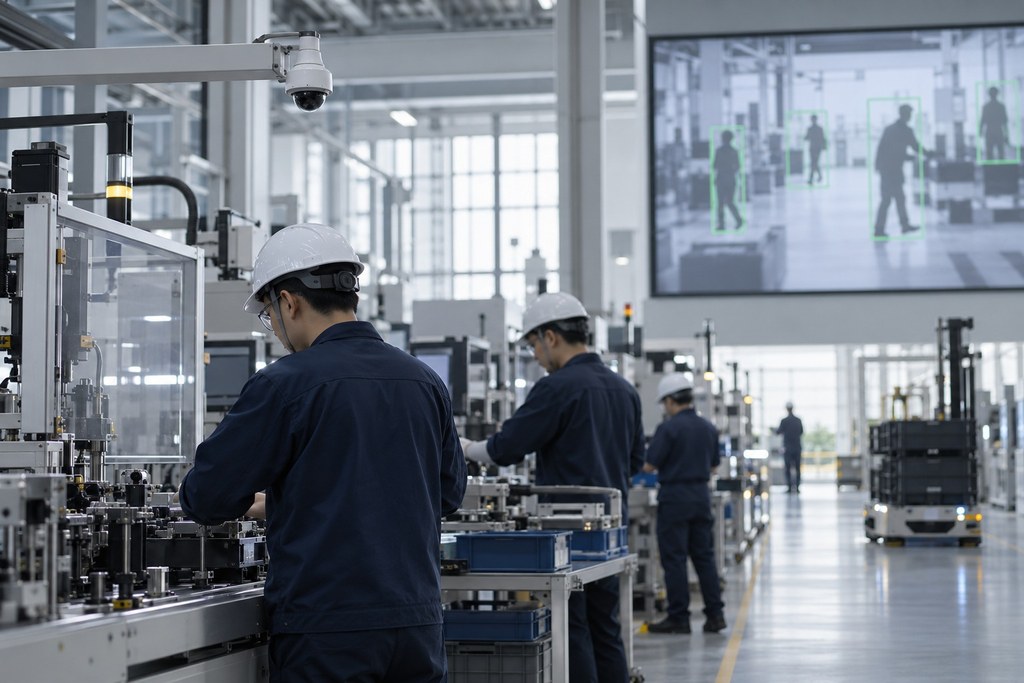
Protecting labor rights is a core part of supply chain responsibility. Visual AI offers new tools for monitoring and safeguarding workers, enabling effective oversight of working conditions while respecting privacy.
Intelligent monitoring of workplace safety protects workers' basic right to a safe environment. Vision systems can check whether workers are wearing protective equipment such as hard hats, safety clothing, and goggles, identify hazards in work areas, and monitor environmental indicators such as harmful gases and noise. Real-time monitoring makes it possible to detect and prevent accidents early.
Automatic time tracking prevents excessive overtime and unlawful labor practices. Using facial recognition and behavior analysis, the system records working hours automatically and ensures compliance with labor regulations. It is more accurate and harder to falsify than traditional time clocks.
Child labor detection and age verification technology helps eliminate child labor from supply chains. Using biometric recognition and age estimation algorithms, systems can automatically flag suspected underage workers and trigger manual review and intervention. This technology provides strong support for protecting children.
Workload health assessment focuses on workers' physical and mental well-being. By analyzing indicators such as movement frequency, fatigue, and emotional state, the system can assess whether workload is reasonable and help prevent occupational illness and overwork. These assessments help improve working conditions and protect worker health.
Privacy-preserving technology ensures monitoring systems do not infringe on workers' fundamental rights. Data masking, anonymization, and access controls protect personal privacy while upholding labor rights. This balance is a key consideration in applying visual AI to workforce monitoring.
Smart Auditing for Environmental Compliance

Environmental protection is a core responsibility of modern supply chain management. Visual AI offers an objective, accurate, and efficient way to monitor and audit environmental compliance, tracking indicators in real time and preventing violations.
Emissions monitoring is central to environmental compliance. Using spectral analysis and image recognition, vision systems track the color, density, and frequency of smokestack emissions and automatically flag exceedances. This contactless approach works in real time and covers wide areas.
Monitoring wastewater treatment helps protect water resources. Vision systems can track the operating status of treatment facilities, measure the clarity and color of treated water, and detect equipment anomalies, so problems are identified and resolved quickly.
Visual tracking of solid waste enables oversight from start to finish. By identifying the type, volume, and handling of waste, the system ensures hazardous waste is disposed of properly and recyclables are put to effective use. This tracking makes waste management more transparent and efficient.
Remote sensing offers a macro view of ecological impact. Satellite imagery and drone surveys can track vegetation cover, water conditions, and land-use change around factories. Monitoring at this scale provides a scientific basis for environmental impact assessment.
Automated compliance reporting eases the administrative burden of environmental management. Using monitoring data, the system can generate a range of environmental compliance reports for regulators and stakeholders. This automation improves efficiency and reduces the risk of human error and falsification.
Trust mechanism for blockchain integration
Combining blockchain with visual AI creates a tamper-proof foundation of trust for supply chain transparency. The integration ensures data authenticity and establishes a decentralized trust mechanism.
Automated on-chain workflows ensure information is recorded promptly. Images, video, and analysis results collected by vision AI systems can be encrypted and uploaded to a blockchain network automatically, creating a tamper-proof history. Automation reduces the room for human interference and makes the data more trustworthy.
Smart contracts enable evidence-based automated decisions. When vision AI detects a defined condition or event, it can trigger contract execution automatically: payments, alerts, transfers. This makes supply chain operations more transparent and efficient.
Multi-party consensus makes data more trustworthy. Multiple supply chain participants can jointly verify data collected by vision AI, using consensus algorithms to confirm its authenticity. Multi-party verification is more convincing than a single party's claim.
Privacy-preserving zero-knowledge proof technology achieves transparency while protecting business secrets. Through zero-knowledge proofs, companies can prove that they meet certain standards or requirements without revealing specific information. This technology balances the needs of transparency and privacy protection.
Cross-chain interoperability enables information sharing across blockchain networks. Supply chains often involve multiple parties on different blockchain systems. Cross-chain technology lets these systems verify and share information with one another, forming a unified network of trust.
Transparent experience for consumer participation

Modern consumers are no longer content to passively receive product information. They want to take part in verifying supply chain transparency. Visual AI gives them an intuitive, interactive transparency experience.
Visual traceability shows consumers the full journey of a product. By scanning a QR code, they can watch the process from raw material to finished product, review quality test results at key stages, and see the manufacturer's certifications. This visibility builds trust.
Virtual live factory tours remove the barrier of distance. Through VR and live video, consumers can tour production facilities, watch the manufacturing process, and see the working environment. This immersive experience conveys the brand's openness and commitment to transparency.
Visual verification of third-party certification provides independent quality assurance. Consumers can watch on-site inspection videos from third-party auditors and see how certification actually works. Visual verification is more credible and persuasive than a paper certificate.
Crowdsourced community oversight invites consumers to help monitor the supply chain. Through a mobile app, they can report quality issues, environmental violations, and labor abuses, uploading photo or video evidence. This widens coverage and raises the likelihood of detecting problems.
Two-way feedback creates a direct connection between brand and consumer. Through visual AI systems, consumers can contact the brand directly with questions, suggestions, or complaints. The brand can respond in real time and show the improvements it has made and their results.
Digital transformation of supplier management

Visual AI is fundamentally changing supplier management, shifting it from document reviews and on-site spot checks to continuous digital monitoring and intelligent assessment.
Automated supplier certification greatly improves the efficiency of onboarding. Visual AI systems can automatically verify suppliers' qualification certificates, inspect production facilities, and evaluate management practices. This automation not only improves efficiency but also reduces the influence of human bias.
Real-time monitoring shifts supplier management from periodic reviews to continuous oversight. With visual monitoring systems deployed at supplier sites, buyers can see production status, quality, and compliance in real time. This makes it easier to spot and resolve issues early.
The intelligence of risk warning improves the forward-looking nature of supply chain risk management. AI algorithms can analyze suppliers' historical performance data, identify risk signals, and predict possible problems. This early warning mechanism shifts risk management from passive response to proactive prevention.
Visual collaboration platforms bring transparency to supplier relationships. By sharing visual monitoring data, suppliers and buyers can build more open partnerships, solve quality issues together, and improve overall performance.
Targeted capability building helps suppliers improve how they manage. Visual AI analysis pinpoints where a supplier falls short, so training and technical support can be focused where they are needed. This precision makes capability building more effective.
Automated Compliance Reporting

Regulatory compliance is a major challenge for every modern company. Visual AI offers compliance management that is automated, standardized, and real-time.
Intelligent interpretation of regulations helps companies understand complex requirements accurately. Natural language processing can analyze regulatory texts, extract key requirements, and translate them into actionable monitoring metrics. This reduces errors in interpreting compliance obligations.
Automated evidence collection keeps compliance data complete and authentic. Visual AI systems can collect and organize the evidence compliance requires, such as production records, quality inspections, and environmental monitoring. Automation makes that evidence more credible.
Standardized report generation meets the requirements of different regulators. The system can automatically produce compliance reports in the format each regulatory standard requires, ensuring accuracy and completeness. This greatly reduces manual work.
Visualized audit support simplifies regulatory inspections. During on-site inspections, companies can provide detailed visual records and analysis reports to demonstrate compliance quickly. This improves audit efficiency and the credibility of results.
A closed-loop improvement process keeps compliance management getting better. Using monitoring results, the system identifies opportunities, sets improvement plans, and tracks outcomes, steadily raising compliance standards.
International Standards and Certification Systems

Transparency in global supply chains requires unified international standards and certification systems. Visual AI is helping drive the development and adoption of these standards.
Technical standards provide clear guidance for applying visual AI in the supply chain. They cover image quality, data formats, algorithm accuracy, and system interfaces, ensuring interoperability across systems.
Digitizing certification makes it more efficient and more credible. Remote visual monitoring can partly replace traditional on-site audits, lowering costs and allowing more frequent certification. A digital process is also more transparent and traceable.
Mutual international recognition makes global trade easier. Certification bodies in different countries and regions can recognize one another's results based on a shared visual AI standard, reducing the burden of duplicate certification.
Technical rigor makes certification results reliable. Visual AI gives the process objective, precise tools, reducing subjective human judgment and making certification more scientific.
Continuous oversight replaces traditional one-time certification. Visual AI monitoring extends supervision beyond certification, ensuring certified entities keep meeting required standards.
Technical Challenges and Solutions

Although visual AI shows great potential for supply chain transparency, real-world deployment still faces many technical challenges that require continued innovation and refinement.
Data quality and standardization are key to AI performance. Images captured across different environments, devices, and lighting conditions vary widely in quality, requiring unified standards for data collection and processing. Techniques such as data augmentation and domain adaptation help make algorithms more robust.
Compute resources and cost control are key considerations at scale. High-precision visual AI algorithms often require substantial compute, and deploying them across a distributed supply chain can create cost pressure. Edge computing, model compression, and cloud-edge collaboration can help optimize resource use.
Privacy and data security are baseline legal requirements. Data collected by visual monitoring systems may include trade secrets and personal information, so robust data protection is essential. Federated learning, differential privacy, and homomorphic encryption can unlock the value of data while protecting privacy.
System integration and interoperability are the technical hurdles of real-world deployment. Supply chains involve different systems across many parties, which must integrate seamlessly and exchange data. Standardized interfaces, middleware, and API gateways help solve integration challenges.
Algorithmic fairness and bias mitigation are core requirements of AI ethics. Visual AI systems must avoid discriminatory judgments and treat all groups fairly. Algorithm audits, bias detection, and fairness constraints help build fair AI systems.
Visual AI is redefining the standards and practice of supply chain transparency. By providing objective, precise, real-time visual evidence, these technologies improve the efficiency and quality of supply chain management and, more importantly, rebuild the foundation of trust in global trade. As the technology advances and adoption deepens, visual AI will become essential infrastructure for transparent, credible, and sustainable supply chains. Companies should embrace this shift, building visual AI into core supply chain processes to improve operational efficiency while meeting their social responsibilities, and earning trust and respect in global competition. Transparency is no longer a cost burden but a source of value. Trust is no longer an abstract idea but a business asset that technology can build and verify.