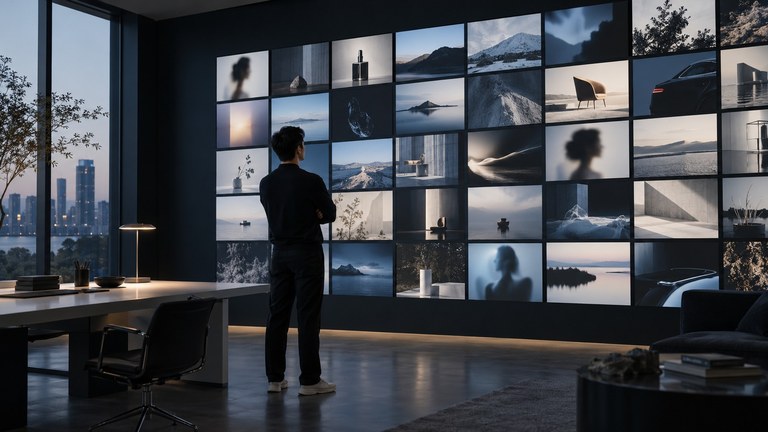
AIGC brand films: a new division of labor from script to final cut
AIGC has changed how brand films are produced, but not simply by having AI replace a single step. The new production model redefines the division of labor from script to final cut: people own creative judgment and narrative structure, AI handles visual generation and asset production, and the two collaborate through iteration. This calls for new workflows, quality standards, and team capabilities.
The core value of AIGC brand films lies not in cutting costs but in expanding creative possibility
In the new model, the human role shifts from end-to-end execution to creative decision-making and quality control
Scripts must evolve from written descriptions into structured visual instructions that fit how AI generates
Visual generation rarely lands on the first try; it converges on the intended result through multiple rounds of iteration
Quality standards shift from technical perfection to narrative integrity, tolerating the visual imperfections of AI generation
Team capabilities must shift from traditional production skills to mastering AI tools and integrating creative work
01AIGC changes more than production efficiency
Most companies see AIGC as a way to cut the cost of making brand films: AI-generated footage instead of live shoots, AI voiceover instead of the recording studio, AI editing instead of manual post-production. This view is not wrong, but it is too narrow. The core value of AIGC lies not in doing things more cheaply, but in doing what was previously impossible.
In our experience, the real advantage of AIGC brand films is creative freedom. In the past, many ideas never made it beyond the script because of shooting costs and technical difficulty. AI-generated imagery removes these constraints, making even the most imaginative visual concepts achievable. More importantly, the generation process itself sparks new ideas. When experimenting with different generation parameters, the unexpected results AI produces often bring pleasant surprises. Creative exploration on this scale would be prohibitively expensive in traditional production, but becomes feasible with AIGC.
The core value of AIGC lies not in doing things more cheaply, but in doing what was previously impossible.
02The new division of labor: people judge, AI executes
AIGC brand film production is not about AI replacing cinematographers, editors, or animators; it is about redefining the roles of people and AI. People own creative judgment and narrative structure; AI handles visual generation and asset production. The logic is that the heart of creative work lies in understanding the audience, mastering emotional rhythm, and making aesthetic judgments, which AI cannot yet do. Generating visual elements, varying imagery, and realizing effects, on the other hand, are things AI can do faster and with greater variety than people.
In terms of process, human work concentrates on three stages. The first is creative concept: defining the film's core message, narrative logic, and emotional arc. The second is visual direction: translating the concept into structured generation instructions that tell the AI what imagery, style, and pacing are needed. The third is quality control: selecting the material that meets expectations from the large volume AI generates, discarding what doesn't fit, and deciding whether to regenerate. AI's job is to produce multiple versions quickly from those instructions, giving people ample room to choose.
03Rethinking the script: from written description to visual instructions
A traditional brand film script is a written description that tells the production team what to shoot, what lines to deliver, and what music to use. The team interprets the director's intent from the script and turns it into a plan for shooting and editing. This model relies on the crew's experience and rapport, with a great deal of implicit communication along the way.
An AIGC brand film script must be restructured as structured visual instructions. Instead of writing “showcase the product's sense of technology,” specify “deep blue palette, geometric lines in dynamic composition, slow push-in, two-thirds of the frame left empty.” Instead of writing “convey a warm brand tone,” specify “warm light source, soft focus, close-up of a person at the center of the frame, smiling.” This kind of script is not creative copy for people to read but a parameter list for AI to execute. It requires creative teams to translate abstract concepts into concrete visual elements, a core skill people must master in the new division of labor.
Framework
AIGC brand film production process
The complete process from creative planning to final review: human–AI collaboration, with people stepping in at key decision points and AI handling execution and trial and error.
Step 01Creative planning
Define goals, audience, and core message; establish narrative structure and emotional tone
Step 02Scriptwriting
Translate the concept into structured visual instructions, including shot descriptions, style parameters, and timing
Step 03Initial generation
Use AI tools to generate first-draft imagery from the script instructions, producing multiple candidate options
Step 04Evaluation & Iteration
Select imagery, identify what falls short of expectations, and adjust instructions to regenerate
Step 05Editing and assembly
Edit the selected imagery into a film following the narrative structure, adding voiceover, music, and subtitles
Step 06Final review
Evaluate the film for overall narrative integrity and brand consistency, making fine adjustments where needed
Note: This diagram is a conceptual framework. It explains a way of thinking and is not statistical data. Source: Qingmei Future Insights.
04Iterative generation: converging on intent through trial and error
AI-generated imagery rarely lands on the first try; it converges on the intended result through multiple rounds of iteration. First generations often fall well short of expectations: the style may be off, the composition weak, or the details inaccurate. This is normal. It is not a flaw in the AI tools but a characteristic of how they generate. The key to iteration is adjusting instructions based on results, rather than expecting AI to grasp intent on its own.
Iteration requires clear criteria for judgment. After each generation, assess whether the imagery serves the narrative, whether the visual style is consistent, and whether the core message is clear. If not, identify which parameter caused the drift and adjust the instructions to regenerate. In practice, we typically need three to five rounds to achieve satisfactory imagery. The process takes time, but it is still far faster than rework in traditional production. More importantly, the many versions produced along the way provide a rich pool of material for the edit.
05Quality standards: from technical perfection to narrative integrity
The quality standard for traditional brand films is technical perfection: sharp imagery, accurate color, smooth motion, seamless editing. AIGC brand films require a different standard. AI-generated imagery may contain technical flaws, such as blurred details, distorted objects, or discontinuous motion. Judged by traditional standards, most generated content would fail.
The new quality standard should center on narrative integrity: Does the imagery convey the message effectively? Does the pacing follow the emotional arc? Is the overall style consistent? As long as the narrative holds, technical imperfections are acceptable. In some cases, the unreal quality of AI-generated imagery can even become a distinctive visual style. This shift requires teams to let go of their fixation on technical perfection and embrace the nature of AIGC. It also means communicating with clients and audiences so they understand these are creative choices, not production errors.
06The complete process from script to final cut
Bringing these stages together, AIGC brand film production can be organized into six steps. Step one is creative planning: defining the film's goals, audience, and core message, and establishing its narrative structure and emotional tone. Step two is scriptwriting: translating the concept into structured visual instructions, including shot descriptions, style parameters, and timing. Step three is initial generation: using AI tools to generate first-draft imagery from the script instructions, producing multiple candidate options.
Step four is evaluation and iteration: selecting imagery against narrative needs and quality standards, identifying what falls short, and adjusting instructions to regenerate. Step five is editing and assembly: cutting the selected imagery into a film following the narrative structure, and adding voiceover, music, and subtitles. Step six is final review: evaluating the film for overall narrative integrity and brand consistency, and returning to earlier stages for fine adjustments where needed. At the heart of this process is human–AI collaboration: people step in at every key decision point, while AI handles execution and trial and error.
07Team capabilities: from production skills to mastery of AI
AIGC brand films demand different team capabilities from traditional production. Mastery of camera equipment, lighting setups, or post-production software is no longer essential. What is needed is an understanding of how AI tools generate, the ability to turn ideas into effective generation instructions, and the judgment to choose from large volumes of output. These capabilities are not taught in traditional film education; they must be explored and built through practice.
Team building can proceed on two fronts. One is developing existing creative teams' proficiency with AI tools, using real projects to help them understand the tools and master generation techniques. The other is bringing in talent experienced with AI tools, while strengthening their narrative and aesthetic judgment. The ideal team combines three roles, creative planning, AI tool operation, and quality control, working together across the full process from script to final cut. As AIGC tools become widespread, this new kind of team will become the standard for brand film production.
Recommended actions
Action 01
Pilot a project to establish the new process
Start with a short video or a single brand film and run the full AIGC process from script to final cut. Build experience through practice and identify the key bottlenecks and areas for improvement.
Action 02
Develop structured script templates
Turn creative descriptions into visual instruction templates AI can execute, with fields for visual elements, style parameters, camera language, and more. Standardizing scriptwriting reduces iterations and improves generation efficiency.
Action 03
Establish quality assessment standards
Define the dimensions for assessing AIGC brand film quality, focusing on narrative integrity rather than technical perfection. Set criteria for selecting imagery to help teams decide quickly which results are usable and which need to be regenerated.
Action 04
Train team capabilities
Provide AI tool training for creative teams, with focus on understanding generative logic and mastering prompt-writing techniques. Simultaneously build quality control capabilities, enabling teams to make informed judgments between narrative coherence and brand consistency.
AIGC at scale introduces new brand consistency challenges. Shift from pre-production control to process monitoring and post-production refinement, establishing asset libraries, generation rules, and dynamic monitoring systems.
AI changes the efficiency of design, not its essence. Designers should focus their judgment on defining goals, selecting options, and signing off final work. Judgment is the irreplaceable core capability.
Professional PerspectivesJune 30, 20267-minute read
An education institution's website is no longer a static showcase but a brand platform that uses AI marketing to deliver personalized experiences and drive conversion.